The method
“The Body Speaks™”

The “The Body Speaks” method is based on the belief that pain is not merely physical, but is closely linked to the nervous system, emotions, and the body’s internal communication. Science now confirms what the body has always known: our experiences, stress, and unprocessed emotions are stored in the body and can manifest as tension, discomfort, and chronic pain.

This method integrates movement, mindfulness, and therapeutic principles to help release these patterns at their source. Corrections intégrées

The Body Speaks

The body speaks long before the mind understands.

Beneath every tension, every pattern, every sensation, there is a message — a subtle language through which the body expresses what has not yet been fully felt, processed, or released. Rather than something to fix or silence, the body becomes a guide.

The Body Speaks is a refined, integrative method designed to decode this language. It brings together science, somatics, and intuitive awareness to reconnect you with your body’s innate intelligence. Through this approach, the body is not forced into change — it is listened to, supported, and gently guided back into balance.

This method invites a deeper relationship with yourself, where transformation is not imposed, but emerges naturally from within.

Understanding Trauma in the Body

Trauma is not defined only by what happens to us, but by what the body is unable to process in the moment.

It can result from experiences that are too intense, too fast, or from a prolonged accumulation of stress over time. When the natural responses of fight, flight, or freeze are interrupted or suppressed, the body retains this unresolved energy.

What is not expressed does not disappear — it becomes stored.

Over time, this can manifest as chronic tension, emotional imbalance, fatigue, or a persistent sense of disconnection. Research increasingly shows that these imprints can extend beyond the nervous system, influencing cellular function and even mitochondrial health, subtly affecting energy levels and overall vitality.

The Body Speaks method works with this understanding. By creating safety within the body, it allows these stored responses to gradually surface, release, and integrate — restoring flow where there was contraction, and vitality where there was depletion.

Learn more

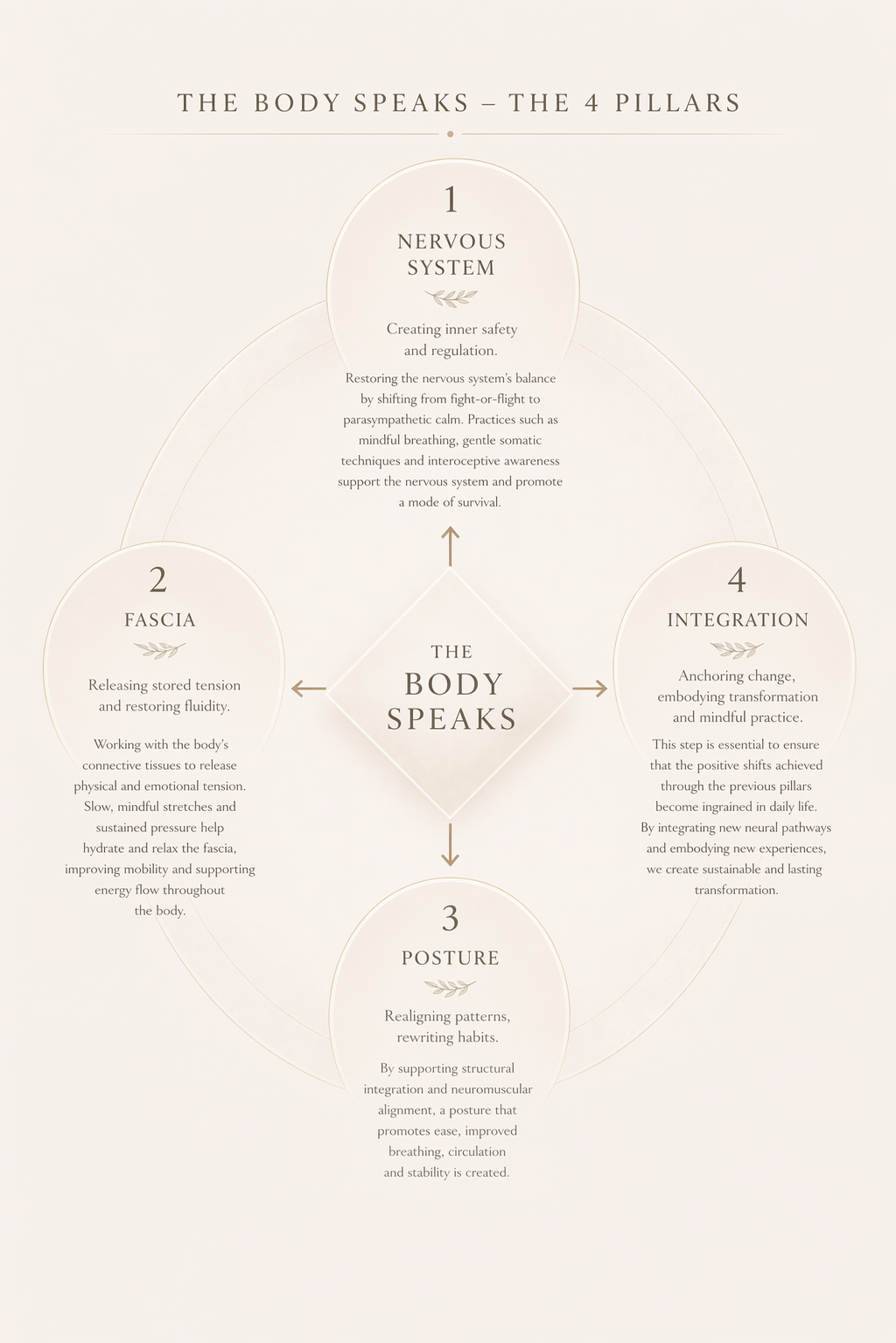
1. Nervous System – Creating safety and regulating stress
The nervous system is the foundation of all physiological and psychological experience, continuously scanning for cues of safety or threat through processes described in Polyvagal Theory. Chronic stress shifts the body into sympathetic dominance, impairing digestion, sleep, emotional regulation, and cognitive clarity. Within “the body speaks” method, we prioritize restoring parasympathetic balance by cultivating internal safety through breathwork, interoceptive awareness, and gentle somatic practices. This approach is deeply aligned with the principles explored in The Body Remembers What the Mind Doesn't, where unresolved experiences are understood to persist in the body beyond conscious awareness. By regulating the nervous system, we create the biological conditions necessary for healing, resilience, and sustainable well-being.
2. Fascia – Releasing stored tension and restoring flow
Fascia is a dynamic, interconnected network of connective tissue that envelops muscles, organs, and nerves, playing a crucial role in force transmission, proprioception, and fluid movement. Scientific research increasingly recognizes fascia as a sensory organ capable of storing mechanical and emotional tension. Repetitive stress, trauma, or inactivity can lead to densification and reduced elasticity, impairing mobility and circulation. Through slow, mindful movement and sustained holds inspired by practices such as Heal Your Body and Your Mind with Yin Yoga, the method facilitates fascial hydration, release, and reorganization. This process restores biomechanical efficiency and enhances the body’s natural capacity for self-regulation, allowing energy and movement to flow with greater ease.
3. Posture – Understanding patterns and realigning the body
Posture reflects the cumulative imprint of habits, emotions, environment, and nervous system states. It is not merely a structural issue but a functional expression of how the body adapts to life experiences. From a biomechanical and neuromuscular perspective, inefficient postural patterns can lead to chronic pain, joint overload, and decreased respiratory capacity. In “the body speaks” method, posture is assessed as a living pattern rather than a fixed position, integrating awareness, alignment strategies, and functional movement retraining. Accessible approaches, such as those presented in Yoga on Chair Against Anxiety, demonstrate how even subtle adjustments can significantly influence both physical comfort and emotional states. By realigning the body, we support optimal function and restore coherence between structure and experience.
4. Integration – Transforming awareness into embodied change
True transformation occurs when insight is translated into consistent, embodied practice. Integration bridges the gap between cognitive understanding and physiological change by reinforcing new neural pathways through repetition, attention, and lived experience—principles grounded in neuroplasticity. This pillar ensures that shifts achieved through nervous system regulation, fascial release, and postural awareness become sustainable rather than temporary. The method emphasizes gradual adaptation, self-awareness, and personalized application, allowing individuals to internalize change at both the neurological and behavioral levels. In alignment with the philosophy of The Body Remembers What the Mind Doesn't, integration acknowledges that lasting healing is not achieved through insight alone, but through the continuous embodiment of new patterns that reshape how we move, feel, and relate to ourselves.

When pain isn't just physical

Have you ever felt that your physical pain might be linked to your emotional state? Not as some abstract idea, but as something you sense subtly, deep within your body.

  • A tension that surfaces during times of stress.
  • A discomfort that lingers for no apparent reason.
  • A pattern that keeps coming back, even when you take care of yourself.

You stretch. You build strength. You correct your posture. And for a while, it helps. But then the pain returns, in the same spot, with the same intensity, as if something deeper hasn’t been addressed yet.

Glossaire

A question that changes everything: Why does the body keep falling back into the same patterns?

Over the course of more than 20 years as a movement therapist in Geneva, I have guided hundreds of clients through rehabilitation, postural work, and therapeutic movement.

The results were often significant: improved alignment, reduced pain, and greater mobility.

And yet, many returned with the same recurring symptoms.

Glossaire

At some point, the question became unavoidable:

Why does the body revert to the same patterns, even when physical work is precise and effective?

The body is not merely mechanical

The answer isn’t purely physical. Many forms of chronic tension aren’t simply structural. They are adaptive responses to prolonged stress, internal pressure, and emotions that haven’t been fully expressed or processed

These experiences do not disappear. They are held in the body, in the fascia, in the breath, and in the way posture develops over time.

Your body isn't malfunctioning. It's just reacting.

What you feel as tension or pain isn’t random. It’s a signal. It’s not something to be ignored, but something to be understood. A sign that your system is holding onto more than it can process.

When Awareness Transforms the Body

Over time, I have observed a consistent pattern:
When a person becomes aware of the emotional dimension underlying their physical symptoms—not just intellectually, but through a embodied experience—the body reacts differently. The movement becomes more effective. The release becomes more lasting. And the pattern no longer needs to repeat itself in the same way.

Why focusing solely on the body is often not enough

Strength, flexibility, and alignment are essential.

But without addressing:

  • the nervous system
  • internal perception (interoception)
  • emotional processing

The body tends to revert to familiar patterns. This is because these patterns once served a purpose. A more integrative approach

An integrative approach:
The “Body Speaks” Method

This understanding has led to the development of an approach that integrates:

  • fascia and body memory
  • nervous system regulation
  • therapeutic movement (Pilates & Yoga)
  • emotional awareness

A Different Approach to Pain: A New Path Forward

Pain isn’t always something to be eliminated. It can be a point of entry. A form of communication that invites you to pause, listen, and understand what your body is holding onto.

A new path to follow

Your body isn’t working against you. It’s expressing what hasn’t yet been fully processed. And when you learn to work with it, rather than against it, change becomes possible—not just physically, but deeply and sustainably.

Move from theory to practice

Join our next training session and learn to listen to what your clients’ bodies are trying to tell you. Develop unique expertise in somatic therapy and myofascial release.